Pages

Showing posts with label Reserved Forests. Show all posts

Saturday, July 25, 2015

Re-discovering Koraput : Day-5

Route : Jeypore-Balia-Boipariguda-Ramagiri-Gupteswar
            And return via the same route.
The trek up and down Duduma waterfall on day-4 had left us high and dry. We were sleeping on the verandah of our farmhouse. It was nearly 7 when we woke up and someone handed me a glass of steaming hot decoction of tea dust and sugar, a very good beverage to refresh the senses. Thankfully the fatigue of the previous day was gone to a great extent. I wasn't feeling tired from the muscle anymore. The morning was bright and chilly. Birds were singing their morning songs everywhere around. A pair of black-hooded oriole and the magpie robin were singing much closer to us on the two Mohua(Madhuca indica) tree in-front of the house. Listening to the bird calls Udayan remembered the promise I had made to him earlier. He had not yet seen the Red Avadavat or Red Munia(a small and colourful bird of the size of a sparrow, males are bright blood red in colour with white dots). I had promised to show him the birds in our farm where they are found in very good numbers. The parts of the farm which is left uncultivated is always invaded by weed and wild grass and the flock of these Munia are very fond of feeding on the seed of these grasses. I have seen flocks numbering 200 birds feeding in our farm. These flocks generally consists of  more than three or four species of Munias. We set off on a walk through the fields in the hope of finding the munias. Though there was grass in some patches of the field but the birds were not there. 
Here let me tell you something about the location of our farm. Our farm is situated 12 kms south-west of Jeypore town, near the place where the gorge of river Kolab ends and the river runs off out to the flatter parts of the plateau. One has to take a right turn from the state highway at the end of Patraput village and traverse exactly 1.8 kms towards the village Durgabhatta and our farm house appears on the right hand side. My maternal uncle bought 15 acres of land in the year 1997-98 here. Later in year 2003 my father bought another 15 acres adjacent to it. River Kolab flows 200 mtr south of our farm and we draw water from the river for irrigation purpose. My uncle and my brother look after the farm. We grow a variety of crop here. Aromatic plants such as Jamarosa, Vetiver, Lemon Grass and Citronella are major crops at the farm. A small distillation unit has been set up there to extract the oil from these plants. These aromatic oils find various use in cosmetic and other such consumable goods.

When we didn't find our target species of bird we proceeded towards the small perennial stream that skirts our farm towards the north boundary. The bank of this stream is overgrown with scrub and shelters many passerines. The birds that I always spot near the stream are Long-tailed Shrike, Common Hoopoe, Scaley-breasted Munia, Indian Silverbill, Yellow-eyed Babblers, Ashy Prinia, Common Tailor Bird, Common Quail,  Grey Francolin, Black-shouldered Kite , Indian Nightjar, White-throated and Common kingfishers and many more. A pond was dug out nearer to the stream, half an acre in area. It dries up as soon as the rains are gone but the deepest part of the pond remains wet till early summers and it is this wet part that is overgrown with Ipomoea weed and many small birds have made it their safe heaven. We did not have to search too far. There they were. The Red Munia's. A few males and females were going in and out of the Ipomoea bushes. A small blue kingfisher was also perched on a Ipomoea branch. Udayan went after the munias to take a record shot. I sat on the bank of the pond, basking my back in the morning sun. I kept my promise, Udayan saw his bird. It was time to leave for Jeypore.

A frugal breakfast was awaiting us at Purunagarh(my ancestral home). We lost no time in finishing off whatever was served. Our ancestral home at Purunagarh was built by my grand father way back in 1970's. The house is more like an old British bungalow with a porch and large garden space. All living quarters and bedroom doors open to the verandah, the kitchen and store have entry from the back yard. The garden borders the house on the east and north. The garden to the east is a jasmine garden that was very lovingly planted by my great grandmother way back in the 70's and it continues to bloom every summer without exception. To the south of this jasmine garden there are two mango trees, two tamarind trees, one neem tree and two coconut trees. One of the mango trees is much older than the house itself. Though its fruits are not so great to taste but it provides the much needed shelter to many birds of the garden. A colony of common myna and a jungle owlet share the tree. The jungle owlet being nocturnal uses the dense foliage and the hollows of the mangifera as a day time resort. The mynas do not mind sharing their territory with the owlet as it doesn't harm them or their fledglings. But they are at constant threat from the pair of shikra who nest close by on the bigger tamarind tree or the silver oak in our neighbours compound. The jungle owlet was also a bird that I had promised to show to Udayan. It didn't take us long to find the bird as it was sitting on an open branch of the neem tree, doing up its feather in the sun after a busy nights wandering.

We returned to Bada Maa's house to snatch an hours nap and then got ready for our ride to Gupteswar. Since we had a late breakfast we decided to have lunch either at Boipariguda or Gupteswar. We left Jeypore close to 1 o'clock. The sky looked fantastically blue with blotches of clouds in the western horizon. Sidhu was accompanying us this time and was riding my Enfield and I retired to the pillion to take pictures. We reached Boipariguda and bought some refreshments there. Then we rode on to Ramgiri village which is a sizeable village at the fringe of Gupteswar forests. Gupteswar is exactly 13 kms from Ramgiri. The road from Boipariguda bifurcates at the beginning  of Ramgiri village. The right one leads to Kundra and the left one proceeds to Gupteswar. I had visited Gupteswar on two occasions earlier. Once from Jeypore and from Kundra on another. Due to my misjudgement we proceeded a furlong along the road branching off to Kundra but the open farmlands and the absence of a police outpost made me realize that we had been going in the wrong direction. I signaled Udayan to turn back and we were once again on the right path. The police outpost of Ramgiri was blown up by the naxalites a few years ago and a small company of BSF jawans now man the outpost. Few sentries are always kept on guard in the bonkers and they keep their assault rifles aimed on to the road all day and all night. The sentries gave us penetrating looks as we passed on the road. Forest proper begins a couple of kilometers from the police outpost.
"The sky looked fantastically blue with blotches of clouds in the western horizon"
"An Abandoned iron suspension on Sati river on the way between Jeypore and Boipariguda"
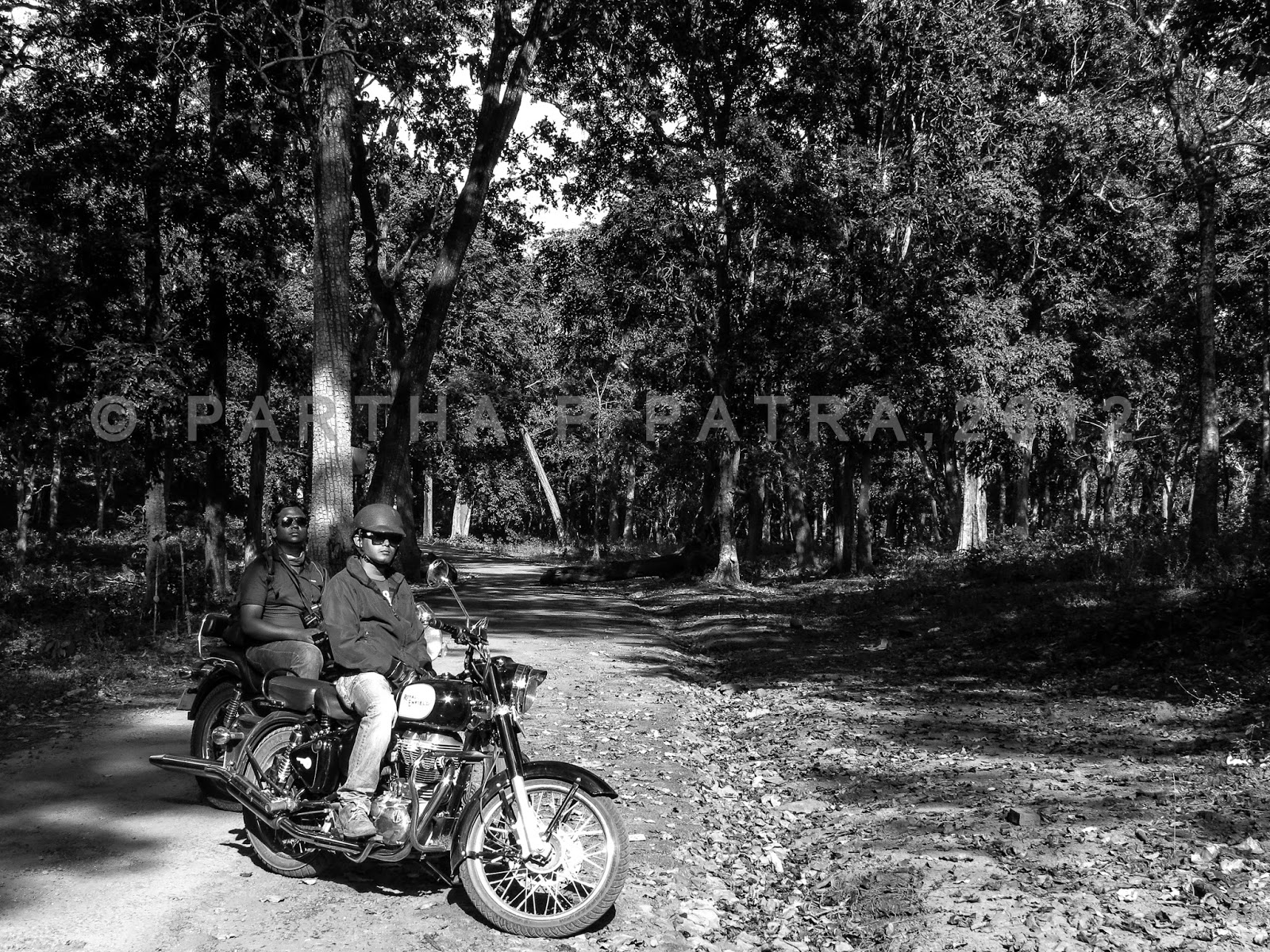
SIDHU WITH THE CLASSIC 350
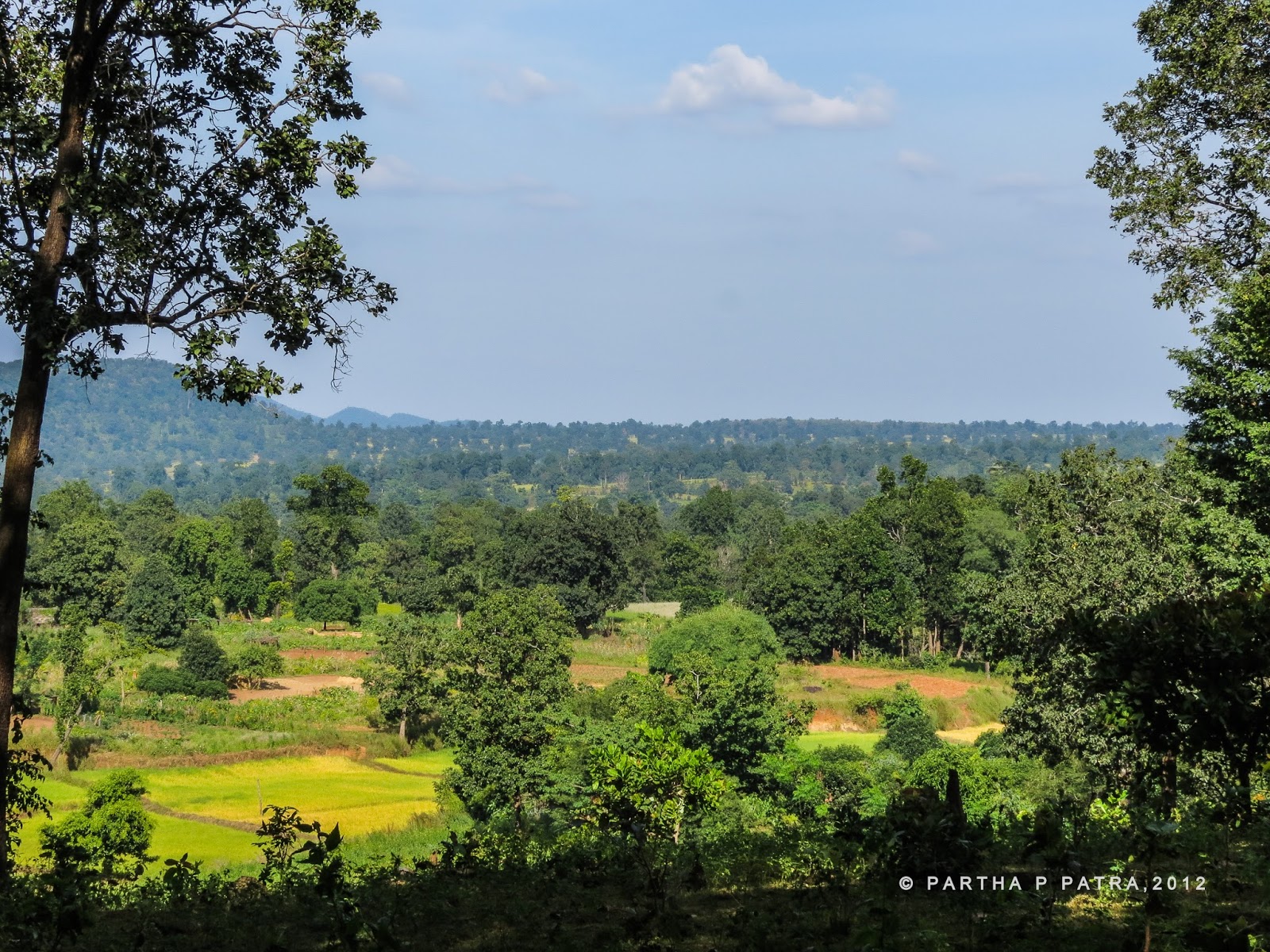
LANDSCAPE BETWEEN BOIPARIGUDA AND RAMGIRI

Gupteswar forests are the remnants of a vast forest scape that was known as Dandakaranya. The loot of forest resources from Koraput, by natives as well as outsiders, in the last few decades has reduced this forest to a mere few hundred square kilometers of dis-integrated forests dotted with numerous human habitations, leaving little or no room for the diverse wildlife that once inhabited them. Notwithstanding these facts wildlife has subsisted in the remaining patches of less disturbed forests. The pristine vegetation is one of the few remaining patches left in India today of its kind and the birdlife is astoundingly rich. My subsequent birding ventures in these forest has yielded as many as 100 species during the span of a single day.

FOREST PROPER BEGINS 

As we pushed ahead the vegetation got denser. We stopped at the famous "Dalkhai" shrine that marks the beginning of a steep ghat named "Dokri Ghati", (Dokri in Koraputia means an old lady). The steep road looses elevation of nearly 100 meters within a distance of half a kilometer. This slope was even steeper in earlier days which made the ghat a treacherous road to travel on. Negotiating the ghat either way on bullock carts and other vehicles was a nightmarish experience. Even vehicles with four wheel drive found it difficult to traverse. Many of them have rolled down this ghat resulting in human or animal casualty. Travellers pay a darshan at the Dalkhai shrine and pray for a safe passage through the treacherous ghat. The obeisance is paid in the form of a small branch or a bunch of small branches that is laid at the feet of the deity "Dalkhai". This is a custom that is followed by travellers very religiously and local people sell bunch of branches, a rupee apiece, and make a small income out of it. We also paid our homage at the shrine and had a small chat with the pujari(priest) of the place and enquired about the wildlife in that locality. Since the shrine is located at the shoulder of a hill, it commands a majestic view of the surrounding forests. Forest stretches upto the horizon in the west. The hills clothed with pristine sal forests roll down up to the river Kolab. The other side of river Kolab is Chattisgarh forests. I took a few photographs from this point and we rolled down this steep ghat. I have on earlier occasions trekked in the southern aspects of this forest. Now I recall those experiences with a lot of delight. But the forest looked a whole lot different while riding through it.
DALKHAI SHRINE 

FOREST AS FAR AS YOUR EYES CAN SEE -VIEW FROM DALKHAI TEMPLE 

THE ROAD DOWNHILL-DOKRI GHATI

AT THE END OF THE STEEP DOKRI GHATI


We reached Gupteswar at around 3 o'clock and went straight to the bathing ghat on river Kolab(Sabari/Saveri). This place offers a spectacular view of the rocky river and surrounding jungles. We went for a stroll upstream along the river expecting to sight a few birds but all in vain. Except heaps of human excreta we saw nothing. Retracing our step we went to the small market place near the shrine where petty vendors sell sundry items to tourists. There are a few eateries that serve tea, snacks and frugal meals. Few shops sell the goods that is offered to lord Gupteswar as offerings and some locals also sell local forest produce such as honey and sal resin(also known as Jhoona). Here at this market place we met a person from Jeypore who has taken to the life of an ascetic and living in one of the caves near Gupteswar since last one and half decades. He used to be a computer hardware and software professional at one point of time and somehow got fed up with his banal existence and resorted to a living that he regarded diviner. He greeted us in fluent English, taking us to be tourists from far off places. But once I gave him my introduction , over cups of tea, he opened himself up through a fulsome conversation in the course of which we discussed things ranging from wildlife to computer languages. He also told me that he knew my father well. We said good bye to him and went loitering down the narrow concrete pathway that leads to the caves of ""Parabhadi"which are situated on the other western side of the same hill that houses the main Gupteswar cave. The name means "abode of pigeons".
KOLAB/SAVERI RIVER 


THE CONCRETE PATHWAY LEADING TO PARABHADI
Hardly did we know, as we ambled down the pathway, that the the next couple of hours will turn into an jamboree of bird sighting. The first bird to appear was a Velvet-fronted Nuthatch. As typical to the birds belonging to nuthatch/creeper family, this bird was also creeping upside down on the branches. A Velvet-fronted nuthatch is impossible to miss in a tree due to its bright and contrasting colouration. The sighting of this bird thrilled us.To be honest I was least expecting the bird in the vicinity of the cave as this area is mostly frequented by bipeds. The next hour or so  turned out to be a pleasant surprise as we spotted many interesting birds like Vernal Hanging Parrot, Indian Yellow Tit, Brown-capped pygmy woodpecker, Brown-cheeked Fulvetta, Tickell's Blue Flycatcher, White-rupmed Shama etc.
BROWN-CAPPED PYGMY WOODPECKER
BROWN-CHEEKED FULVETTA-THE SKULKER OF THE BUSHES

VELVET-FRONTED NUTHATCH- THE ULTIMATE ACROBAT

VERNAL HANGING PARROT

SONGSTER OF THE INDIAN JUNGLES 
TICKELL'S BLUE FLYCATCHER
The birding sprint drew to a close as light started to fade away rapidly. We decided to head back to the road where we had parked our motorcycles. On our way back I had an interesting chat with a elderly man who was happily puffing away at his tobacco leaf(colloquially called a "sutta", "dhungia" or "pikka"). He was a man from nearby Siribeda village which is mostly inhabited by a tribe named "Dhurua". Pointing to the hills to our west the old man told me "Babu, you see that huge rock? Last year in the month of  "Pus"(peak winter) I had seen a "bagh" and its cubs playing and basking in the sun. Not on one occasion but many times. Not only me but many people from the bazar also have seen it". Now a "bagh" in Koraputia can mean anything from a tiger to hyaena. Secondly after years of interaction with my jungle dwelling friends of Koraput, I have learnt to take their words with a pinch of salt as their narration of events is very very prone to exaggeration. Hence I assume it to be a leopard if it was a big cat at all. Because no tigress, how bold it may be, would not raise its cubs so close to human settlement and in a place that has very depleted prey base. On my part it is only wishful thinking that big cats continue to roam these beautiful forests and live in harmony with human beings.
ENTRANCE TO THE PARABHADI CAVE

TIME FOR SOME BIRDING 

Add caption

The ride back to Ramgiri and onward to Jeypore was a cherished one in complete darkness of night. Time of twilight had also elapsed by the time we were heading back. There were no stops till Ramgiri. This was not for the first time that I was running down that road at night. But this time the road had an  eerie charm of its own. Centuries old sal trees towered on both side of the road. Their huge trunks and the retro-reflective plates fixed to them by the R&B division reflected the beam of my bright motorcycle head light. The constant motion though the towering trees carried me away to the games that I used to play as a child on computer. The lone rider going through the forests of night. Not a single human soul passed us in those 13 kilometers. Only a lone jackal, a jungle cat and a fox at three different locations were all that of wildlife we saw on the way. In my class 3 books there was this true story about the chowkidar of a forest bungalow of Mathpada(very close to Ramgiri) and his blood-curdling encountered  with a tiger inside the bungalow compound. Those were the days when tigers were plenty in these forests. So naturally these were the favourite hunting grounds of  Maharaja of Jeypore and his guests. But now there is no sign of any tigers nor their prey. I will not talk about the destruction brought upon these forests here. I have written a detailed passage about it some time earlier on this blog.
Just after crossing Ramgiri we stopped on the road near Mathapada. Parked our bikes on the road side and sat right on the road to soak in some silence and tranquil environ of the sal forest. Except for the constant trill of the cicada there were no other sounds. Not even the familiar hoot of an owl. But I imagined, sitting on the lonely jungle road, somewhere deeper in the forest a Brown Fish Owl must be perched on its vantage point besides a stream, awaiting its night meal. On some high branch of the sal tree a Scops owl must be hooting away its constant childlike muffled syllable -Unh-Unh-Unh-Unh..... Not too far away a bruin must be searching and digging termite mounds to suck out the juicy white ants as there is no dearth of them in these forests. A cunning and clever jackal must have taken its position near some village hut to chance upon a chicken from the pen. A good 15 minutes we sat there in silence until a pick up van passed on the road at full speed.

A cursory visit to some of our relatives  and  a few cups of hot tea later we left Boipariguda and headed for Jeypore. On the way again a jungle cat crossed our path. I stopped the bike and Sidhu went down to the road edge to see where it had gone. The cat after seeing us approach had gone into a paddy field were paddy was almost waist high. The cat had gone into a bush and its eyes were reflecting the light of Sidhu's torch from a bush across that field. The cat had its lair in that bush where it was perhaps tending is kittens as we could hear the meowing of the small kittens and also the resentful snarls of the mother cat. Just then Sidhu tried to step down into the paddy field with the light still on the bush. The mother cat let out a shrill snarl and jumped into the paddy field and came leaping though the paddy grass like a bouncing ball, snarling repeatedly. I watched all this from the elevated road. It stopped after coming half way down the field. I called Sidhu back and told him to leave the family alone. It was really a lesson that even an animal as small as a jungle cat can charge down on human beings to protect its young.

At about 9 o'clock we reached back at Jeypore and headed straight to the famous Girija fast food joint which serves Jeyporias their daily share of chicken soup and egg roll. This small treat was to celebrate the successful close to Day-5 of the trip.

The forests of Gupteswar hold a special place in my life. I have always enjoyed trekking up and down its densely wooded hill sides the most. Watching its birds and wildlife gives me immense joy. One of my candid confessions is I wish these forests are protected and restored to their former glory, full of life and full of gods beautiful creations. So that I can drive down these forests, as an old man,  in a jeep with my grand children and point to them a sambar stag scratching its antlers against a tree, a sloth bear rubbing its back against a scaly sal tree, a colony of hill mynas whistling their sweet notes, a beautiful leopard bounding across the road and melting away into the bushes, to take them on a stroll along a stream bed and to enjoy a cold lunch of sandwiches. Is it too much to ask for? I think our coming generations have every right to these small pleasures of life. Don't they?


Tuesday, June 29, 2010

Predicament of Pachyderms


Undivided Koraput district of Odisha is known throughout the state for its rich forest resources and biodiversity. Most of the major fauna of peninsular India are encountered here with the only exception of the Asian elephants. The movement of elephants was confined only to Chandrapur forest range of present day Raygada district due to its proximity to forests of Phulbani and Kalahandi district where these huge beasts are found in good numbers. Strangely enough pachyderms were never sighted in any other part of the district in last hundred or more years, although the habitat is ideally suitable for them (abundance of bamboo). But in a startling turn of events few elephant herds have been found straying into the Koraput and Jeypore forest divisions in last three years. Elephants were alien to these forest divisions or at least this is what the record of forest department says. A herd of about thirteen elephants had ventured into the Koraput forest division from Kalahandi district(most likely from Karlapat WLS area). During past few months this herd caused a lot of damage to crop and property in Dasmantpur and Laxmipur block of Koraput subdivision. Even more alarming is the fact that within last one month itself four adult elephants of this herd were reported to have died. Similarly another herd was spotted depredating Borigumma and Jeypore blocks. One adult from this herd was found dead in a paddy field near Bsinghpur village of Borigumma block. At least three people have lost their lives to this herd. Most of the districts of Odisha witness similar episodes everyday. Pathetically poor and ineffective forest management by the state government is only to be blamed for this. Last one decade saw a huge loss of forest cover due to mining and shifting cultivation. Except for a few Vana Surakshya Samiti formation and planting few acres of plantations, the forest department is literally doing nothing in the state. Though the state is singing songs of own praises that forest cover has increased, the real picture is something distant from that. En bloc the forest cover might have increased but natural forest cover (pristine forest) is disappearing rapidly, especially in the districts of Koraput(Undivided) and Kandhmal. Last summer was the summer of most number of forest fires in the state. Even the well protected Similipal Biosphere reserve could not pass the worst. The elephants, in specific, are worst hit by this loss of habitat as they require large tracts of forest that can fulfill their need of green pasture. This has also resulted in widespread migration by these beasts. People from the area to which these elephants migrate resist the arrival and starving elephants have no hesitation whatever to forage on the crops of these folks. Subsequently loss of life follows from either side. If the area to which the elephants migrate turns out to be a land where elephants were never heard of or seen, then things can only get worse for the people. As people are unaware of the ways to tackle with pachyderms, they end up being the victims. On the other hand elephants also become the victim of the counter violence; either they get injured by gunshots fired by some irate villager or die due to starvation if people choose to guard their crop instead. Though region we are discussing here has forest cover but the forest is mostly fragmented and moderately dense. This directs the elephants to paddy fields and villages. Here in Koraput three of the four deceased elephants are said to have died out of hunger and dehydration. Every now and then forest official shoo away the herds towards Kalahandi forests but only to find them back after 10-15 days in the same forest. Though people have not caused any harm to the elephants so far but their patience can not be put to test for long. It is pointless to add here that such migrations have disastrous implications on man, animal and the environment equally. 


The above case is yet another reminder to us that it is us who ravage the home of wild animals first. Hence everything else that result will be considered our own handiwork. We, the Homo sapiens, are the only creatures on earth who have been blessed with the ability to think and foresee the future with deft precision. Tagged as most intelligent of all living beings, we manipulate and stage-manage things expecting results that go well with us, but unfortunately in many cases things don’t go that well as we want them to, at least not in the larger scheme of things. Our damned dams kill rivers, our industries mar wetlands, our factories poison lives in every form, our highways spell doom for wildlife, settlements we build for ourselves deny food to many other creature and the list goes long. We must ask ourselves-Is this what we should be doing to prove ourselves befitting for the Most Intelligent tag? I have this view that a Life lived is dubbed well lived only when it has succeeded, even in the smallest way, to make this world a better place for others to live in. I write this last line remembering the legendary Jim Corbett who lived his life following this simple mantra. Can’t we?

Tuesday, June 22, 2010

An Appeal


In the great epic of Ramayana there is reference to a densely wooded region of India where lord Rama, his spouse Sita and his younger sibling Laxmana spent a major part of their exile from Ayodhya. This great forest was described as ‘Dandakaranya’ where many dramatic events were encountered by these three. Mythology apart but this forest were believed to be one of the densest jungles of India and harbored many wild animals. The forests of present-day Koraput, Malkangiri of Odisha, parts of East Godavari district of Andhra Pradesh and the Bastar district of Chattisgarh are believed to be the same as ‘Dandakaranya’ of Ramayana. Till the late fifties this vast expanse of jungle was literally untouched and virgin, aborigine tribes such as the ‘Koya’,‘Bonda’,‘Poroja’ and ‘Kondh’ being the only dwellers. It is said that just prior to independence, when a major chunk of this region was under the princely state of Jeypore, the Maharaja of Jeypore used to pay a forest revenue that was more in comparison to the agricultural revenue he was paying to the British government. You can very well imagine the forest scenario then. Though the ‘Koya’ and ‘Bonda’s mainly survived on hunting and collection but the ‘Kondh’ tribe lived on shifting cultivation or ‘Podu’ as it is known in colloquial language. Podu way of cultivation harms the jungle to a great extent. However till that time the jungles were not at all adversely affected owing to these practices by the tribes. The simple reason was-the population was meager. Then with independence came the various projects which could not have materialized without much damage to the flora and fauna.

First of its kind was the Dandakaranya project under which the Bengali refugees(displaced by the formation of new East Pakistan or existing Bangladesh) were given a new home in our big nation with even a much bigger heart. The procedure was to clear off the priceless pristine forests, convert them to agricultural land, and distribute them to the countless homeless refugees. This process of denuding the forest was very idiotically termed as ‘reclamation’. As if the forests once upon a time were fertile agricultural land and then the forest had swallowed them for some reason. In the whole process hundreds and thousands of square kilometers of Sal and bamboo forest came crashing down under bulldozers, rendering thousands of wild animals homeless and finally falling prey to the guns and arrows. Great beasts like the Tiger (Panthere Tigris), wild Buffalo (Bubalus Bubalis) and the majestic Indian Bison (Boss Gaurus) were part of this list. Better not to mention of other innumerable small creatures. The forests near Umarkot, Raighar of present day Nowrangpur district, most part of Malkangiri district and parts of Kondagaon area of Bastar almost disappeared, thanks to the Dandakaranya project. It is not possible to assess the damage that must have been done to the ecosystem throughout the process of clearing forest to settle more than five hundred villages for the rehabilitation of refugees. This was one heart ripping tale of destruction.

Second to follow was the construction of an ambitious hydroelectric and irrigation project at Balimela in existing Malkangiri district. This claimed the home of the wild buffaloes along with many other herbivores and carnivores as the Kondakamberu valley submerged after the construction of a dam at Balimela on the river Sileru. This project was being vehemently opposed by environmentalists yet the government went ahead with the project. One of the finest but lesser known tiger habitats of the country went under water and subsequently the buffaloes were wiped out of the face of the district. Gradually other wildlife such as tiger, sambhar, spotted deer etc. faced similar fate. One can refer the book authored by Er. Balkrishna Sheshadri titled ‘The Twilight of India’s Wildlife’ to have an insight to the topic. The author was a member of the Environmental Impact Assessment committee formed to report the effect of the project. 

Now whatever was left after this could have been saved. But the lack of farsightedness in the then governments was exemplary and this lacuna resulted in continuous exploitation of these forests and wildlife. Huge forest resources attracted many people to the region. Every one wanted to make a quick buck out of timber. Then some paper industries started to take advantage of the abundant bamboo that was available in the region. These semi deciduous forests constitute of a variety of trees that have many industrial and domestic utility as timber, fuel etc. Nexus between forest officials, timber mafias and some big names in local politics proved to be a force too much against Mother Nature. There are instances where some irresponsible and dim-witted politicians for the sake of vote bank gain encouraged tribals to encroach and cultivate forest land so that they can claim a right over the land and a valid right of record would be issued to them afterwards for the extent of land they have under their possession. The outcome was all but obvious. Every one wanted to have a piece of land as big as possible under their possession. Once again the forest and thousands of its denizens were at the receiving end. 

Such molestation to the forest continues till date. Another problem that has come up in recent time is the naxal menace. Fear of naxalites has adversely affected the forest conservation as the forest officials are apprehensive of going on regular beats in to the forest which has turned home to the naxalites. The poachers and timber mafia take this opportunity to carry out their depredation. 

Apart from all these factors another thing that has a telling effect is population. Mainly the number of forest inhabitants has grown exponentially over the years and so has their demands and dependence on forest. With so many people residing inside the forest and depending on shifting cultivation, it has taken its toll on our forests. To make both ends meet people have started cutting trees for commercial sale of wood which is not at all good news. These people earn a decent sum by the sale of charcoal and young trees which are transported clandestinely to urban centers for house construction. All these activities are carried out right under the nose of enforcing authorities and sometimes with their aid. Had the dependence on forest been confined only to fire wood collection and house hold use of the forest dwellers, the forest would have recuperated itself easily. However the commercial exploitation has made matters still worse. In the month of March-April every year people set to fire the forest carpet which is full of dry leaves owing to the fall. This is a practice rampant in most part of the Dandakaranya region. These fires play a very detrimental role for the health of the forest as they turn the dry leaves and undergrowth to raw ash which otherwise, on decomposing, could have nourished bigger trees as rich bio fertilizer. Apart from being a major source of Carbon dioxide the fires kill innumerable other organisms of the forest floor which are the foundations of the crucial food chain of which we are also a part. Sometimes these fires take the shape of inferno and result in the destruction of hectares of prime forestland and countless wildlife, small and large. 

All these things collectively have led the Dandakaranya to shrink only to a few pockets. But still there is a lot that can be saved and protected. The pronouncement of Kanger Valley of Chattisgarh as a National Park really was a commendable gesture in this regard. More than 200 square kms of virgin forest has been protected under this park. This forest still is the roaming ground for tigers and herds of bison. A healthy population of bison and a considerable number of tigers can be encountered here. The park harbors a rich biodiversity. This is evident from the presence of a balanced mix of herbivores and carnivores .The river Saveri or Kolab forms the eastern boundary of the park and also serves as the border of Chattisgarh and Odisha states. Though the forest on Chattisgarh side is highly under protection, situation on the Odisha side is too gloomy. If we follow the river downstream from the Kotpad block of Odisha it has a very good forest growth on both banks. For the first 10-15 kms the river flows through Odisha. After this it traverses a good 30 kms through dense forest and crossing a few rapids in the course. The holy limestone cave of Gupteswar is situated on the eastern bank and mid way on this 30km stretch. On the Odisha side there is a contiguous belt of dense forest that follows the river from north to south. First comes the Sindhigaon RF. Bordering it and separated only by the road from Boipariguda to Gupteswar is the Dandarkol, Dharamgarh RF, adjacent to these is the Sarangapalle RF. Dandarkol, Dharamgarh and Sarangapalle are the name given to three different areas of a single tract of forest by the forest department to lay down the jurisdictions. The first four reserve forests are in Koraput district. Tulsi RF belongs to Malkangiri district. Except the Tulsi RF, the other four lie on the Eastern bank of the river. The landscape here is breathtakingly beautiful. From the plateau at an altitude of 600 mtrs above mean sea level, the undulating hills after a series of descent give way to the 200 meter plateau on the western side of the great eastern ghat mountains. These hills are a major source of water that feed the important river of Godavari that is a life line of south India. Sal is the predominant tree in these forests. There is also representation of valuable timber like bamboo, Mahogany, Indian Rose wood, Ivory Wood, Ptero Carpus, Sterculia etc. Put together these forest cover a good five to six hundred square kms of contiguous forest, which is rare to be found anywhere in the country today. Small hamlets and villages are scattered in remote corners of these forests. Clearings have been made in between for cultivation but mostly on grounds that are relatively flatter. A major chunk of Dharamgarh RF has, over the years, fallen casualty to the-hunt-for-cultivable-land. Only the hills have been spared from this denudation. Main river that drains the plateau is Saveri. Saptadhara is a major tributary of Saveri. Saprtadhara itself is fed by numerous hilly streams and flows in a roughly east-west direction before it empties into the main Saveri river at the end of the Sarangapalle RF. It can be said to have formed the southern boundary of the Sarangapalle RF and also the vast stretch of forest we are talking about. 

And to talk of wildlife there are still considerable number of Leopards(Panthera Pardus), Wild Boars, Barking Deers, few Sambhars, Sloth Bears, Hyenas and Langurs. Tigers occasionally visit the adjacent parts of Kanger Valley NP. Spotted deer are found in small numbers upstream and downstream of Gupteswar and in the Sarangapalle region. Smaller animals such as Porcupine, Pangolin, Indian Jungle cat, Red Indian Fox etc. are commonly found throughout. The region really is an Ornithologists paradise. Some of the rare birds like the Paradise Fly Catcher, the Racket Tailed Drongo, both the Lesser and the Pide Hornbill, the great Serpent Eagle are also seen. Peafowl and Red Indian Jungle fowl can be easily spotted foraging the clearings inside the forest. Water of river Saveri is the home to many Mugger crocodiles and they are found at various places in the river course. Entire district of Koraput is a rich biodiversity in itself. It is evident from the fact that it was very recently declared as a bio diversity hot spot by United Nation’s Food and Agriculture Organization. It was one among the three places on earth selected for this rare distinction. 

But absence of any kind of protection has facilitated indiscriminate poaching of animals and birds alike. People from the villages near forest make liberal use of their matchlocks(country made gun/muzzle loading gun) to kill Boar, Barking Deer and Spotted Deer. The difference in wildlife between a protected area and an area where no protection has been offered can remarkably noticed in a place called Kechlakadak in this region. This place is about 10 kms upstream of Gupteswar. On the Chattisgarh side of the forest, which falls with in the Kanger Valley NP boundary, there is a teeming population of Cheetals where as just on the other bank of the river, on the Odisha side, there is hardly any spotting. All that we have to do is to offer protection to the forest against felling of trees and poaching of wildlife. This can be done by declaring the forests on Odisha side as a wildlife sanctuary. This patch of forest is already there in the state government’s list of proposed wildlife sanctuaries under the name of ‘Gupteswar Wildlife Sanctuary’. This step can definitely save one of the few remaining patch of forests of Orissa. The Kanger Valley NP and this sanctuary put together will be one of the finest and largest protected forest corridors of India. Apart from protection that it would offer to the many animals and plants, this will also serve as a much crucial extended corridor to the tiger population that exists in the Kanger Valley NP. 

It’s a matter of pity that nothing noteworthy has been done so far towards conservation of forest and the diverse wildlife in the region. Rather we can say that the conservation action is in a state of doldrums. There are no sanctuaries or national parks in the very district which is known through out the country for its unique biodiversity and forest resources. This is high time that some drastic measures have to be taken by the central and state governments, without much ado and delay, to establish at least one wildlife reserve in this part of the state to protect the wilderness that otherwise will perish right before our eyes. This, from the tourism point of view, will also be an added attraction to the eco tourism of the region. The Gupteswar cave is already a famous tourist destination. A wildlife sanctuary around it will undoubtedly draw more number of tourists and more tourists mean more revenue for the state. The tribals and residents of the region will certainly reap the benefit out of it. Active involvement of NGOs and conservation forums is highly called for in this matter. Cooperation from institutions like Indian Institute of Forest Management (IIFM), Wildlife Institute of India (WII) can give a positive direction to this cause. Their help may come in the form of a master plan for the establishment of the sanctuary. Filling up of vacant post in the forest department cadre and deployment of special task force to prevent poaching and illegal timber peddling also has to be done in a resolute approach. Stern action has to be taken to prevent and discourage people from setting the forest fires. The Koraput and Malkangiri being amongst the most backward regions of the state the majority of tribals are illiterate and unaware of the dire consequences the destruction of forest and wildlife can have on their lives. To make them literate and aware will also help a lot in saving our forest resources. This is where various NGOs can play an instrumental role. 

Some governmental policies also need to be rethought of. Sustainable development is the order of the day. Governments at the centre and states are emphasizing on sustainable livelihoods, sustainable energy generation and everything sustainable. On the contrary the government also has passed an act (Forest Right Act) to provide right of record to scheduled tribes cultivating forest land. Such a step, apart from not being a sustainable way to development, will further provoke widespread destruction of forest in the lieu of agricultural land. This act should be revoked if we are to board the train to sustainable development because we are damaging the same track that can lead us to our destination. Natural forests serve as the sink for the carbon emission that occurs due to industrialization. In order to balance or neutralize the carbon emission from rapid industrialization we are bound to increase the natural forest cover and simultaneously prevent their degradation. For this We have to act well before the point of no return is attained. 

Ultimately it is us the people of Koraput and Odisha who must care for this cause. We have to save the beautiful forest and animals of our state for our descendants so that they don’t have to see them only in lifeless pictures or who knows whether they will be there to do so. We already have lost a lot but let’s not lose anymore of it. We have to make sure that, one day, lest we, the human beings, not be the only creatures left on earth. Because, Alone, we cannot survive even for a day. For all that the plant and animal kingdom has been giving us all these times, its our turn now to pay them back A little space for them on this vast earth of ours. A little space for them to live, to grow, to roam about and to make our lives a lot easier. Let us come together to protect our forests and secure a greener and blissful tomorrow for ourselves and our children and their children to come. 

A heartfelt appeal from a lover of nature and wild of Odisha. 


Partha P Patra

e-mail: parthapratim25@gmail.com